
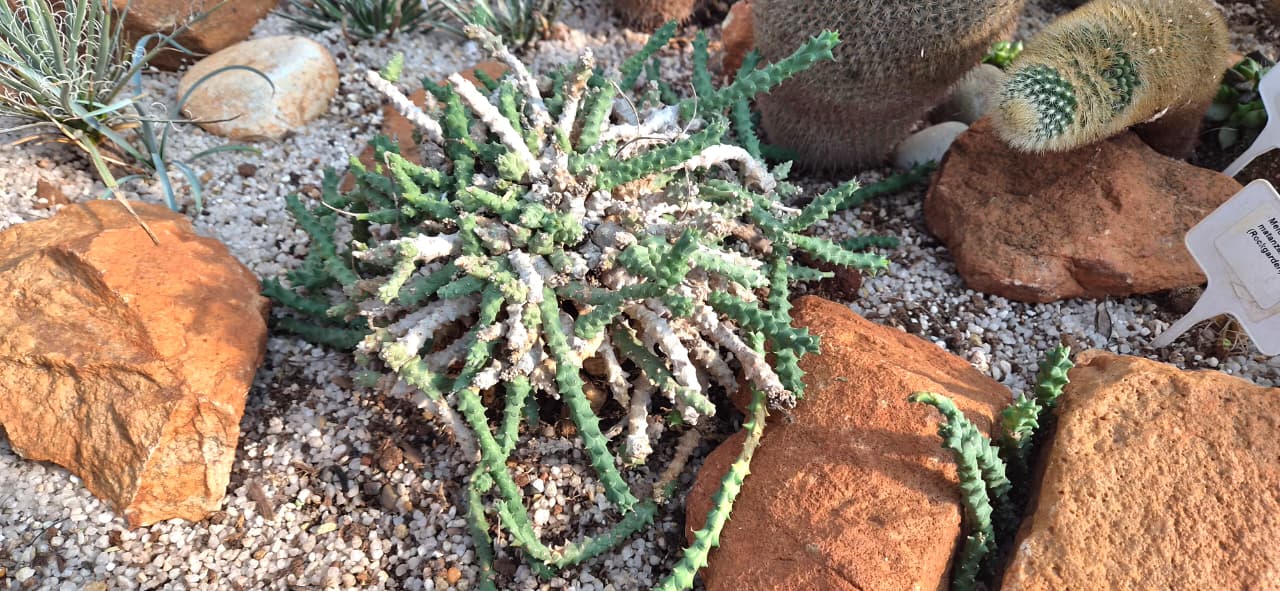
Claws in the Karoo: The Secret Life of Euphorbia ornithophus
Some plants announce themselves. This one doesn’t. No towering stems, no dramatic spines, no showy bloom to catch the eye from across a garden. Euphorbia ornithophus survives by doing the opposite of announcing itself — hugging low to rocky, sun-baked ground, growing so slowly and so quietly that most people would walk straight past it without a second glance. Which is precisely how it has managed to remain one of the rarest treasures in the succulent world.
A Name Written in Claws
The name tells the whole story, if you know where to look. Ornithophus — “bird’s foot” — describes something you’d need to crouch down and study closely to appreciate: the plant’s involucre, a small cup- or envelope-shaped structure, ringed with glands that split into three or four slender, finger-like processes. Splayed outward, they mimic nothing so much as the delicate, clawed foot of a bird pressed into soft ground.
It’s an odd thing to name a plant after, until you actually see it — and then it becomes impossible to unsee. Nature, it turns out, has a sense of humor when it comes to labeling its stranger inventions.
What looks like a flower at first glance isn’t quite one at all. Like every member of the Euphorbia genus, E. ornithophus doesn’t produce true flowers in the way most plants do. Instead, it deploys the cyathium — a cleverly compressed, specialized cluster that packages tiny male and female flowers together into a single deceptive unit, engineered to look and function like one flower while actually being an entire miniature assembly. It’s structural economy at its most elegant: the plant achieves the appearance of a bloom while spending as little energy as possible to build it.
Life on the Edge of the Karoo
Travel to the Southeastern Cape of South Africa, into the dry, rocky, semi-arid terrain around Grahamstown, and you’re standing in one of the most botanically concentrated pockets of Euphorbia diversity on the planet. This corner of the Eastern Cape has drawn botanists for well over a century, its harsh, stony ground giving rise to species found nowhere else on Earth. Euphorbia ornithophus is one of the region’s quieter treasures — a specialist adapted to exactly this kind of unforgiving landscape, where soil is thin, rain is rare, and only the most efficient survivors persist.
Unlike its more famous, heavily armed relatives, E. ornithophus carries no spines at all. It has chosen a different defense entirely: staying low, staying small, and blending into the rock and gravel around it. With age, it develops a caudex — a swollen, water-storing base that thickens slowly at the soil line, banking reserves against the long dry stretches that define its native habitat. It’s not a plant in a hurry. It has nowhere it needs to be, and all the time in the world to get there.
Five Years of Patience, and Counting
There’s something quietly moving about a plant that has spent five years settled into the same patch of xeriscaped garden, deepening its roots, thickening its caudex, asking for almost nothing in return. A sparse watering regime and sharply well-draining cactus-and-succulent soil are all it demands — anything more risks undoing everything its biology has spent millennia optimizing for. And even after five years of steady, unhurried growth, there’s every reason to believe this particular specimen is considerably older still, its true age hidden in growth rates too slow for a human timeline to easily measure.
That’s the quiet paradox of Euphorbia ornithophus: a plant that gives away almost nothing about its age, its history, or its rarity at a glance — and rewards, in equal measure, anyone patient enough to actually look.
Small, Rare, and Easy to Miss — On Purpose
In a world of succulents bred for maximum visual drama, E. ornithophus is a reminder that some of the rarest, most fascinating plants are built to be overlooked. No spines to catch the light, no towering silhouette, no explosion of color. Just a low, spineless rosette, a scattering of claw-shaped glands, and a caudex quietly thickening beneath the surface — a survivor from one of South Africa’s most specialized habitats, content to let the ground around it do the camouflaging.
Look closely, though, and it stops being just another rock in the gravel. It becomes what it actually is: a small, patient masterpiece of the semi-arid Cape, still writing its story one slow year at a time.