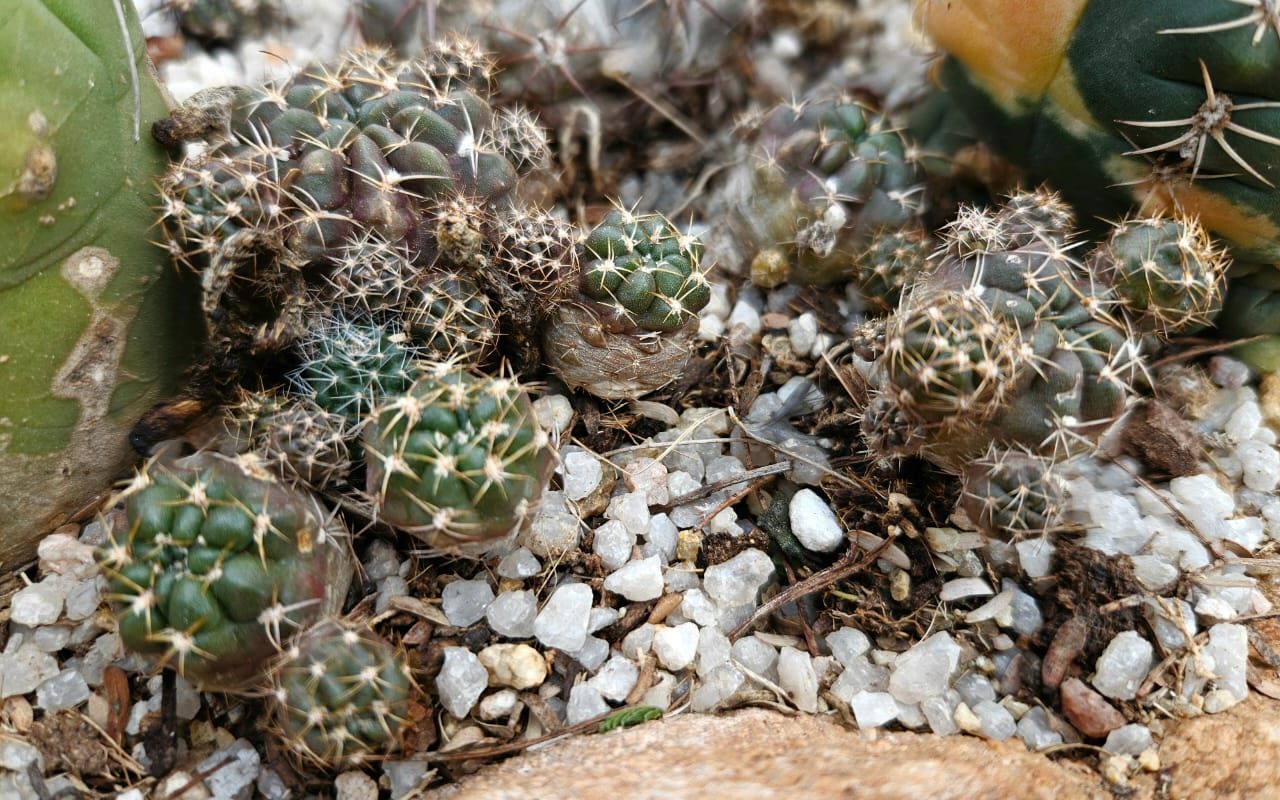
High in the rugged peaks of the Peruvian Andes grows a miniature powerhouse of the cactus world. Matucana aurantiaca subs. polzii is a captivating, clustering member of the Cactaceae family that has fascinated botanists and succulent enthusiasts for decades. With its dramatic spine transformations, prolific offsetting habits, and rare, fiery blooms, this species is a true gem of Western South America.
A Cushion of Tiny Heads
Unlike solitary columnar cacti, Matucana aurantiaca subs. polzii is a miniature species built for communal living. Over time, it vigorously produces “pups” (offsets), eventually forming wide, dense cushions that can consist of hundreds of tiny heads.
Its appearance changes remarkably as it ages. As a juvenile, the cactus features relatively short, pectinate (comb-like) spines that spread widely across its surface. However, as the plant matures into adulthood, it develops much longer, thinner spines, giving older specimens a distinctly different, more formidable texture.
The Elusive, Fiery Blooms
If you manage to see this cactus bloom, consider yourself exceptionally lucky. Matucana aurantiaca subs. polzii rarely flowers because the plant redirects almost all of its energy into vegetative growth—specifically, producing its multitude of pups.
When it does bloom, the display is spectacular:
-
Color: Striking carmine red to vibrant orange.
-
Shape: Funnel-shaped.
-
Symmetry: The flowers are zygomorphic (bilaterally symmetrical). This means the flower can only be divided into two equal halves along a single plane—a rare and highly specialized trait among cacti, which typically feature radially symmetrical (actinomorphic) blooms.
Origins and Taxonomic Debate
This tough little cactus is native to the extreme environments of the upper reaches of the Rio Marañon in Huánuco, Peru. Thriving at altitudes between 2,100 and 2,300 meters above sea level, it has evolved to withstand intense mountain sun and cool Andean nights.
The plant was named in honor of Frank Polz, a German cactus and succulent enthusiast based in Munich whose work flourished around 1986. However, its taxonomy is a subject of ongoing debate in the botanical community. Because Matucana aurantiaca is a highly variable species, many authorities consider the legitimate botanical name to simply be Matucana aurantiaca, grouping polzii alongside several other synonyms and regional variations, including:
-
M. ritteri
-
M. formosa
-
M. intertexa
-
M. huagalensis
-
M. weberbaueri
Whether you call it a subspecies, a variant, or just Matucana aurantiaca, this resilient Peruvian native remains a highly sought-after specimen for any serious collector willing to trade frequent blooms for incredible, cascading growth.