
A Succulent and the Island That Time Left Behind
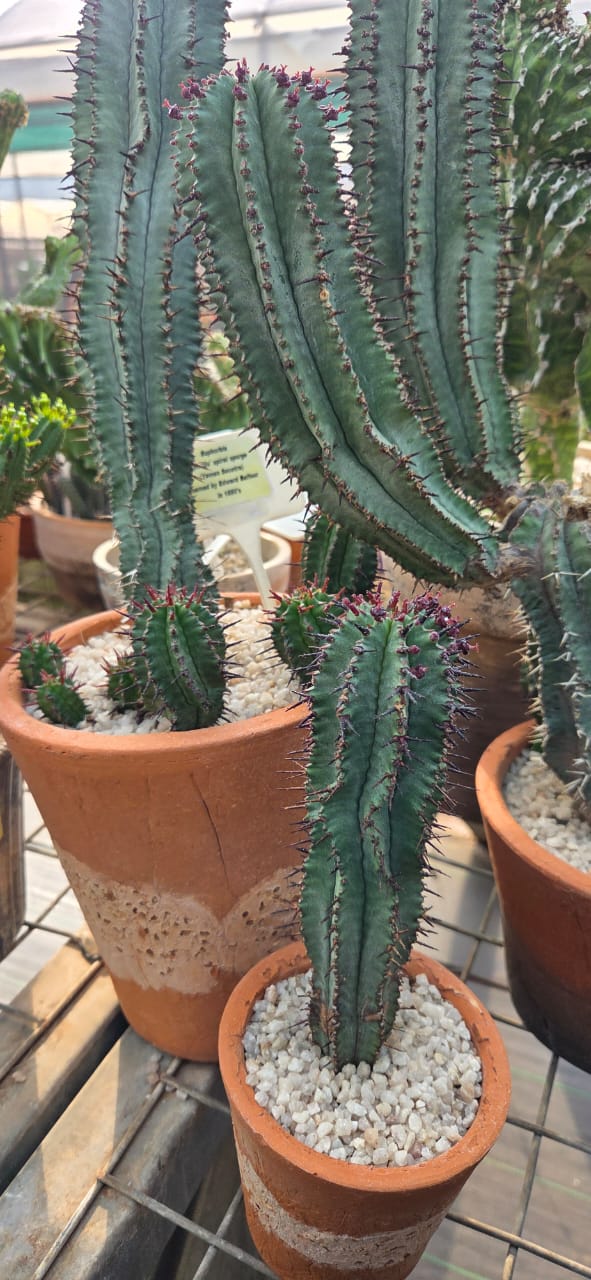 Look at this plant and every instinct tells you the same thing: cactus. Ribbed, spine-studded, standing tall and self-contained against a punishing sun — it has every hallmark of the deserts of Mexico or the Andes. And that’s exactly the trick. There isn’t a single cactus gene in it. What you’re looking at is Euphorbia spiralis, a plant from the other side of the planet that arrived at the same solution to survival through nothing but sheer coincidence.
An Island Unlike Anywhere Else
Euphorbia spiralis grows nowhere on Earth except Socotra — a small, wind-scoured island off the coast of Yemen, so isolated and so strange that botanists often describe it as an alien world washed up on our own. Sparse, open, sun-blasted terrain defines its home: the kind of place where a plant either engineers a way to hoard water or disappears entirely.
Here, the stems of Euphorbia spiralis rise thick and fleshy, ribbed along their length, armed with rows of paired spines running down each ridge like stitching on old leather. There are no leaves to speak of — leaves mean surface area, and surface area means water lost to the air. It is a plant that has stripped itself down to the essentials and kept only what survival demands.
A Name Born of Contradiction
The species carries the name given to it by the botanist Isaac Bayley Balfour, who called it spiralis after noticing a distinctive twist in the stems of the specimens he studied. It’s a fitting name, and also, delightfully, a slightly misleading one: while the specific epithet spiralis coined by Balfour refers to the spiralling of the stem in specimens he observed, stems can in fact be either straight or spiraling, and spiralling itself turns out to be the rarer form. Most individuals of the species never spiral at all. Balfour simply happened to meet the more theatrical version first, and the name stuck — a small reminder that even scientific naming is sometimes a matter of first impressions.
Flowering only adds to the plant’s understated charm. Clusters of small blooms gather near the stem tips, both male and female present on the same plant — though male flowers vastly outnumber their female counterparts, a quiet imbalance that speaks to the plant’s economy: producing seed is costly, so why not stack the odds toward pollen instead.
Convergent Evolution’s Finest Trick
Here is where the story turns genuinely remarkable. Euphorbia spiralis and a saguaro cactus in Arizona share no recent common ancestor. Their lineages split so long ago that, botanically speaking, they are near-strangers. And yet, faced with similar pressures — brutal sun, scarce water, hungry herbivores — both landed on almost identical blueprints: thick water-storing stems, ribbed for expansion, bristling with defensive spines, leaves abandoned entirely.
This is convergent evolution at its most vivid: nature arriving at the same answer twice, independently, on opposite sides of the globe. Fittingly, botanists describe Euphorbia spiralis as strongly reminiscent of the neotropical cacti of the Americas — the word neotropical itself simply designating that shared climatic stage of Central and South America and the Caribbean where true cacti evolved. Euphorbia spiralis never set foot there. It didn’t need to. The same problem, posed twice by nature, produced the same solution twice — one shaped by cactus DNA, the other entirely by Euphorbia.
A Cousin’s Tale: When an Island Left the Mainland
There’s a second act to this story worth mentioning, because it belongs to the same family and tells a mirror-image tale. Far to the south, Madagascar is home to its own dazzling array of succulent Euphorbias — plants that, unlike the arid-adapted Euphorbia spiralis, are classified among the tropical succulents, shaped by a different evolutionary path entirely. The reason traces back hundreds of millions of years, to when Madagascar broke away from mainland Africa and drifted into isolation, carrying its plant life into a private evolutionary laboratory sealed off from the rest of the world.
Two islands, two isolations, two entirely different succulent stories — Socotra hardening its Euphorbias into cactus look-alikes under desert pressure, Madagascar cultivating its own tropical succulent lineage in drifting solitude. Both are proof of the same underlying truth: cut a population off from the rest of the world for long enough, under the right pressures, and evolution will get inventive.
The Real Lesson in the Pot
Stand this plant next to an actual cactus and the resemblance is uncanny enough to fool most people, including plenty of seasoned gardeners. But that resemblance is the whole point. Euphorbia spiralis isn’t a cactus wearing a costume — it’s a completely unrelated plant that independently discovered the same survival strategy, on an island so remote and singular that it’s often called the Galápagos of the Indian Ocean.
It’s a small, spiny reminder that evolution doesn’t care about ancestry when the destination is the only thing that matters: survive the sun, hold the water, outlast everything else.